
Tank Container Components
Depending on the type, the tank container components vary and this guide is provided so you can learn more about tank container components and how they work.
Tanks containers are cylindrical vessels mounted within a standard 20ft ISO frame as would be seen on a standard shipping container. This allows the container to be moved using the same intermodal transport system as a normal shipping container.
Tank containers were developed for the carriage of a range of liquids including foodstuffs, hazardous and non-hazardous liquids.
By using a tank container, the risk of transferring liquids from one vessel to another are greatly reduced, providing a very safe, secure and cost-effective method of transporting a range of powders and liquids.
When the contents to the container have been removed, the unit is then sent for cleaning to remove any residual product that may react of contaminate the next product loaded in to it.
Where we talk about the location of components of a tank container, we will describe their location based on looking at the container from the discharge valve end, this is call the ‘rear end’. The opposite end is the ‘front end’ so, right and left are described when looking at the rear end only.
Components – tank fittings
Airline valve – used for pressuring the tank during discharge of the container contents. Also used for pressure testing and vapour recovery.
Ball valve and butterfly valve – used to control the flow of liquids. Butterfly valves are preferred as they are easier to clean.
Baffles – these are used in baffle containers for use with higher specific gravity products. The baffles provide stability of the contents during transit.
Bursting disc – also known as a rupture disc or frangible disc that’s typically made of PTFE. This thin membrane has two functions. Firstly, it protects the valve from corrosion and secondly, it acts as a pressure release device which ruptures should the pressure in the vessel exceed a pre-defined limit. And is set to a pressure higher than the maximum allowable working pressure (MAWP) and the test pressure.
 Bottom outlet – IMO1 tanks have a bottom outlet that’s similar to that fitted on an IMO2. However, the outlet is flanged and drilled for bolting in accordance with British Standard table ‘D’ and sealed with a stainless steel blanking plate. Bottom outlets cannot be used with certain high hazard contents.
Calibration chart – is used to calculate the amount of product loaded in to the tank (in litres).
Cladding – the container can be clad in either glass reinforced plastic or aluminium.
CSC plate – this is the containers ‘passport’ and contains details such as the unit’s owner, serial number and the date of the next inspection.
Discharge valve – used for removing contents. These usually have 3 shut off devices. IMO1 and IMO2 tanks have a double valve system that consists of an internal valve that’s operated by a foot lever in the event of an emergency, and a 3’’ butterfly valve. The outlet from the valve is further sealed by a blanking cap.
Dip Stick – this is used to measure the amount of liquid in the tank. This is only used with non-hazardous products.
Document holder – this is a tube that’s used to hold documents such as transport action and cleaning certificate.
Earthing point – used to earth the container. Should be connected prior to making any other connections.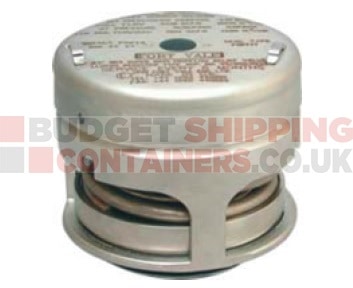
Container frames – there are two basic frame designs – full frame – beam frame. Both of which meet the ISO specification. The full frame has continuous side rails. The beam frame has the frame ends welded in to the vessel shell. This provides the unit with strength whilst lowering its Tare weight thereby allowing it to carry a higher payload.
Fusible link – in the event of fire, the link melts and activates the foot valve.
Gaskets – Standard seals and gaskets vary according to tank type. These components are made of the following materials – PTFE – has a wide temperature tolerance and is resistant to most chemicals. Sweet White Rubber – used for food grade products. Viton A – used for gaskets – tolerant to a wide range of chemicals.
Heating – can be provided by steam, water and electrical systems.
Insulation – about 5omm thick. Can be Polyurethane foam, Rockwool or fibreglass.
Labelling – these identify the product container in the tank. Each time the container is used, the old label is removed.
Manlid – Allows personnel to get in to the tank.
Manometer/pressure gauge – can be fitted during filling, testing and discharging.
Placard boards – used for holding current labels (often used to denote hazardous contents)
Pressure/Vacuum safety relief valve – this is a combined (bi-way) valve that protects the container against over pressure and/or vacuum conditions. The valve opens to relieve excess pressure and allows air in to the tank when under vacuum conditions.
Vessel shell – IMO1 containers are made of low carbon stainless steel. IMO5 gas tanks are typically made from carbon steel.
Spill boxes – 2 stainless steel boxes are fitted around the manlid, relief valve and top discharge/air inlet. They are fitted with 25mm PVC drainage tubes.

Steam trap/relief valve – release cooled down steam in the form of humid hot air and water from the end of the steam coils. This ensures that ‘live’ hot steam continually replaces steam that has condensed. When functioning correctly, this valve will open and close continually.
Syphon pipe – runs from the top outlet to the bottom of the tank. Allows liquid to be discharged through the top outlet by means of pressure or suction.
Tank number – has a 4-letter prefix followed by 6 numbers and a ‘check’ digit. If all other information is removed from the container, the first 3 letters of the prefix can be used to identify the container owner.
Thermometer – displays temperature of the contents.
Top outlet – found at the rear of the container. Consists of a syphon pipe, 3’’ plate or butterfly valve, a 3’’ BS table ‘D’ flange and a blanking plate.
Other components include a walkway and ladders and any other components that a customer requires.
Read more about tank container sales and hire and types of tank containers for further information.
Budgetshippingcontainers.co.uk offer the UK’s largest online range of shipping containers for sale with a nationwide network of storage and conversion yards and crane equipped delivery vehicles.
If you need a shipping container feel free to browse our online range of shipping containers for sale. You can also call us on freephone 0808 1234 215 any time 9am – 5pm weekdays and our team will be happy to discuss your requirements. Alternatively, you can use our online shipping container quote form or request a telephone callback. In both cases we aim to get back to you within 1-2 working hours (may take longer for more detailed quotes).